

The annual AHR Expo Innovation Awards consistently serve as a barometer for where commercial engineering, industrial automation, and HVACR technologies are heading. For 2027, the selections demonstrate a critical pivot in the built environment: bridging legacy field infrastructure with modern computational density, aggressive decarbonization mandates, and autonomous controls.
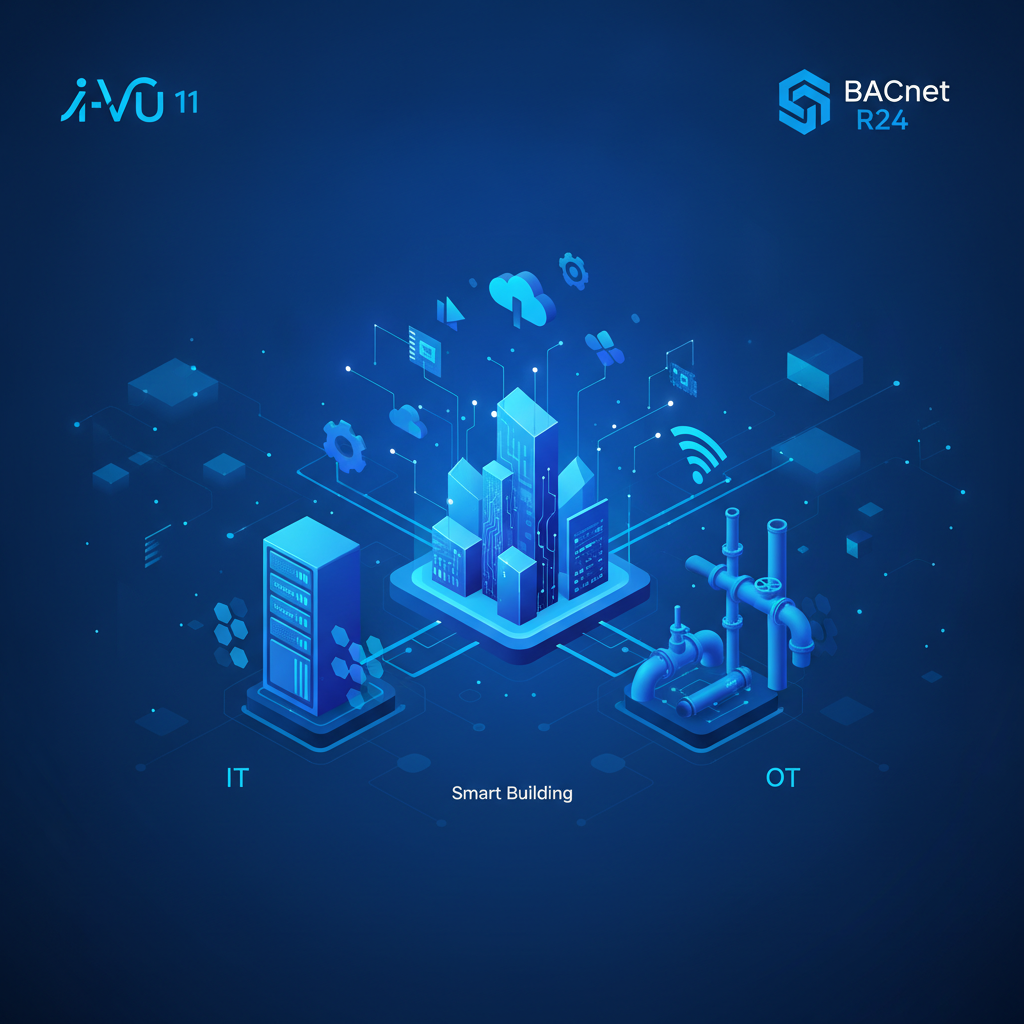
From direct-to-chip two-phase immersion cooling engineered to survive AI server heat loads to wireless field-bus retrofits that eliminate physical RS-485 wiring, this year’s winners highlight practical answers to systemic building bottlenecks. For systems integrators and facility architects, these innovations show that smart buildings are maturing from isolated mechanical silos into tightly synchronized, cyber-physical ecosystems.
Eliminating the Field-Bus Bottleneck: Next-Generation Wireless BACnet
One of the most consequential advancements for building automation professionals is LumenRadio’s W-BACnet Compact, which took top honors in the Building Automation category. Deploying legacy BACnet MS/TP networks across multi-story retrofits has historically been plagued by high labor costs, polarity errors, and grounding discrepancies inherent to daisy-chained RS-485 cabling.
By utilizing an interference-resistant wireless mesh network operating in industrial bands, this hardware enables drop-in replacements for serial runs without sacrificing BACnet protocol compliance, token-passing integrity, or baud-rate synchronization. This development drastically lowers the barriers to upgrading aging air-handling units and variable air volume (VAV) controllers into unified digital architectures.
The AI Computing Surge: High-Density Thermal Management
The cooling and refrigeration sectors are facing historic inflection points driven by exponential data center expansion. As artificial intelligence architectures exceed the thermal dissipation limits of conventional chilled water systems, Chemours received the Refrigeration award for HFO-1336mzz(E), an ultra-low GWP, two-phase direct-to-chip dielectric cooling fluid.
Simultaneously, Thermal Energy HQ’s SkyRadiance captured the Cooling category by exploiting sub-ambient passive radiative cooling via the deep infrared spectrum. Combining deep-sky radiative film with active fluid systems represents an innovative approach to peak thermal shedding—proving that tomorrow’s cooling paradigms will blend advanced thermodynamics with edge-optimized mechanical control.
Automated Compliance and Integrated Life-Safety Verification
Life-safety compliance often remains disconnected from continuous digital monitoring, demanding manual, labor-intensive damper tests to satisfy fire protection standards like NFPA 80 and NFPA 105. Belimo’s FSKN Remote Inspection Module directly resolves this challenge by digitizing remote cycling and position verification of life-safety actuators over native BACnet and Modbus networks.
By turning statutory inspection into automated, digitally verified routines, systems operators can mitigate significant operational liabilities. Real-time telemetry ensures life-safety dampers and smoke evacuation sequences fail into validated positions, integrating mechanical diagnostics directly into central facility supervision.
Unifying Edge Intelligence with Cloud Architecture
While field-level devices—from wireless BACnet mesh nodes to intelligent architectural diffusers—are evolving rapidly, the real challenge lies in aggregating this dense telemetry into actionable facility workflows. Disparate edge protocols and legacy on-premises supervisory engines often struggle to deliver holistic oversight without introducing vulnerabilities into industrial control systems (ICS).
Modern platforms like BAaaS.io bridge this operational divide by delivering Building Automation as a Service. By synthesizing edge telemetry from BACnet networks and life-safety systems into an integrated information sphere, BAaaS.io provides centralized control across multi-facility portfolios. Built-in zero-trust security postures and role-based access safeguard ICS infrastructure, while automated predictive maintenance analytics flag anomalies before mechanical components fail.
Conclusion
The 2027 AHR Expo Innovation Award winners clearly reflect an industry transitioning away from fragmented hardware toward interconnected, high-performance operational intelligence. Whether resolving physical cabling constraints via wireless BACnet mesh, managing extreme heat densities in mission-critical environments, or streamlining compliance through automated testing, the focus has shifted to operational continuity and carbon reduction.
As commercial infrastructure becomes increasingly sophisticated, asset owners who adopt open-protocol edge devices coupled with scalable cloud management architectures like BAaaS.io will be best positioned to optimize energy efficiency, enhance tenant comfort, and secure long-term asset value.