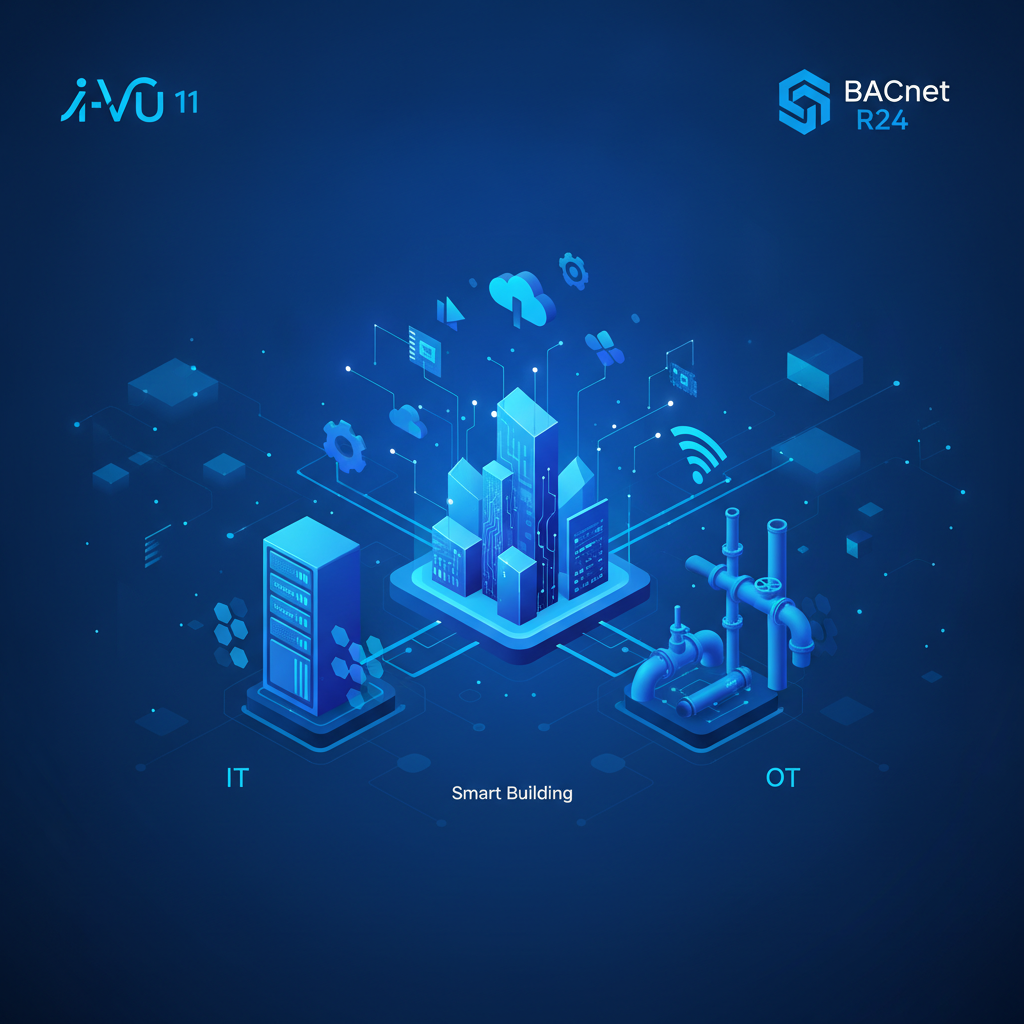


For decades, commercial building automation has wrestled with a stubborn divide: rigid, vendor-locked proprietary building networks on one side, and ruggedized, highly deterministic industrial control platforms on the other. Phoenix Contact is directly addressing this fragmentation with the launch of its Catan C1 open control platform, an automation engine powered by PLCnext Technology.
Designed to modernize legacy infrastructure while establishing a resilient foundation for new developments, Catan C1 fuses modular DIN-rail hardware, an integrated KNX IP router, and industrial-grade software adaptability. By bridging the gap between factory-floor reliability and commercial facility operations, the platform delivers the agility necessary to handle modern building workflows.
Bridging Industrial OT and KNX Field Networks
The core advantage of Catan C1 lies in its convergence of industrial field engineering with standard room automation. With a native, built-in KNX IP router and deep integration with software solutions like Symcon, the controller functions as a multi-protocol hub capable of harmonizing KNX lighting and shading with BACnet, Modbus, and MQTT field assets.
By bringing the platform into the PLCnext Technology ecosystem—spanning Control, Engineer, Store, and Community—Phoenix Contact allows automation engineers to program building sequences using standard industrial tools. This open architecture eliminates the traditional boundary between process control and facility management, enabling single-room control or multi-trade supervisory orchestration from a unified engineering environment.
Navigating Smart Grid Integration and European Energy Mandates
Modern commercial buildings can no longer operate as passive energy consumers. European regulatory frameworks—specifically Section 14a of the German Energy Industry Act (EnWG) and Section 9 of the Renewable Energy Sources Act (EEG)—demand active grid interaction, transparent energy accounting, and automated load-shedding capabilities.
The Catan C1 tackles these requirements directly by hosting sophisticated energy management applications at the edge. Integrators can execute dynamic load control, throttle EV charging infrastructure during peak grid congestion, and log real-time consumption profiles without introducing complex external gateways or custom PLC logic.
Unifying Open Edge Hardware with Cloud-Native BMS Architectures
While advanced edge controllers like the Catan C1 resolve the challenge of physical hardware orchestration in the control cabinet, large commercial real estate portfolios and corporate campuses still face operational hurdles when aggregating disparate sites into a cohesive supervisory layer.
This is where enterprise solutions like BAaaS.io complete the digital twin architecture. Operating as a cloud-native Building Automation as a Service platform, BAaaS.io natively ingests telemetry across all six standard automation protocols—KNX, BACnet, Modbus, LonWorks, LoRaWAN, and MQTT—normalizing field points from distributed controllers into a unified data model without requiring costly on-premise supervisory servers or fragile VPN tunnels.
By coupling edge-resilient controllers with BAaaS.io, facility teams gain access to real-time telemetry, automated indoor environmental orchestration, and cross-protocol closed loops. For instance, high-density LoRaWAN IAQ sensors can dynamically recalibrate BACnet VAV airflow and trigger KNX circadian scenes, all observed within a single operational pane of glass.
Hardware-Rooted ICS Cybersecurity and Circular Engineering
As building automation systems become increasingly connected, IP-level field buses represent high-value attack vectors. Catan C1 integrates defense-in-depth security principles directly into the silicon, incorporating a hardware-backed Trusted Platform Module (TPM) for device identity, secure boot mechanisms, and cryptographically signed firmware.
Beyond digital resilience, Phoenix Contact has prioritized physical lifecycle sustainability. The entire Catan product family is Cradle to Cradle Certified®, emphasizing circular economy design, material transparency, modular repairability, and long-term durability. This design ensures that modern smart buildings meet both stringent decarbonization targets and strict IT/OT compliance standards.
Conclusion
The introduction of the Phoenix Contact Catan C1 marks an important shift toward truly open, secure, and industrially validated smart building control. By blending native KNXnet/IP routing with an expandable PLCnext software stack and robust hardware security, the platform proves that building automation no longer needs to rely on proprietary lock-in. When combined with cloud-native supervisory platforms, these open edge solutions establish the standard for future-ready, energy-resilient real estate infrastructure.