
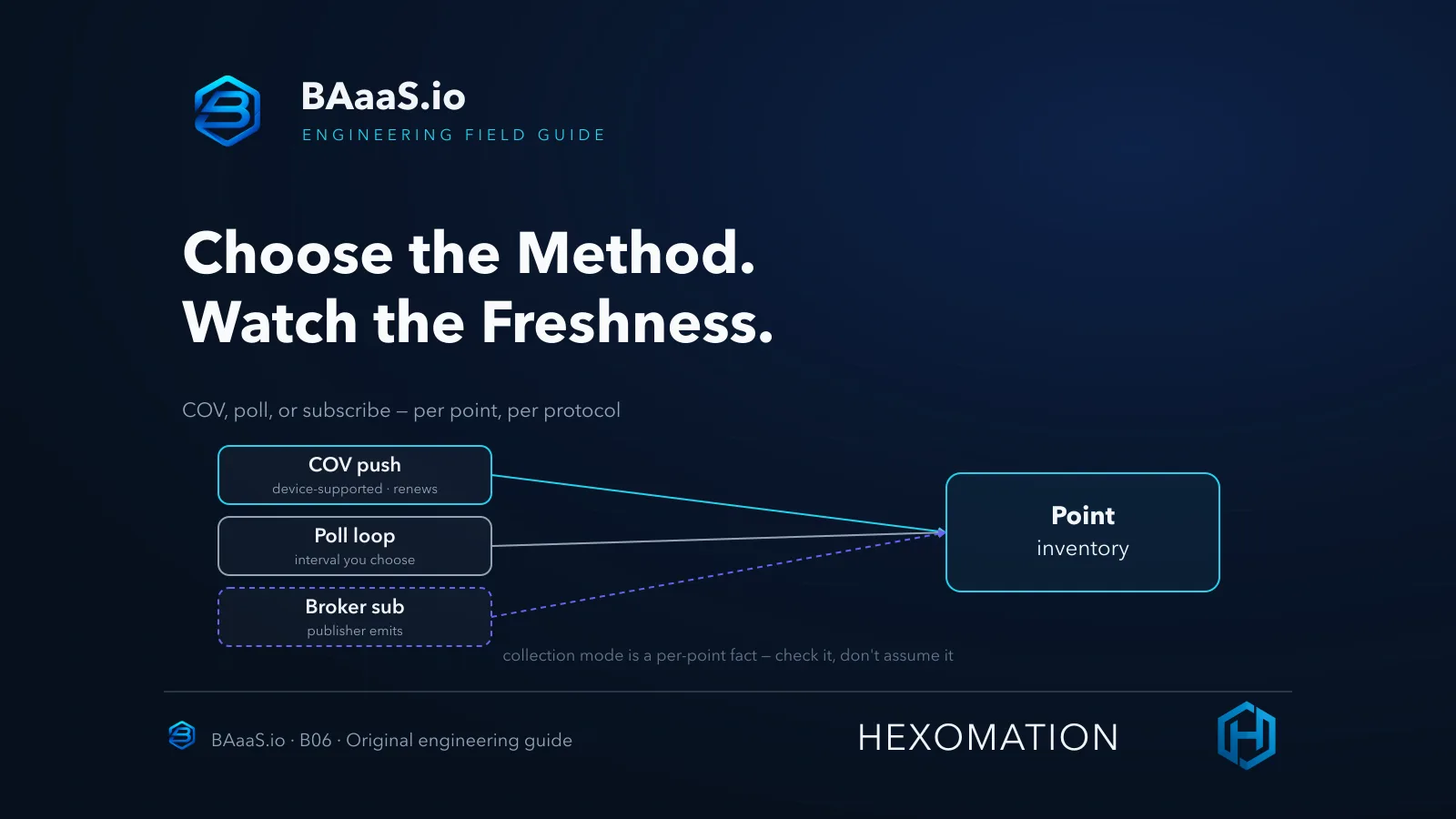
Discovering a point tells you it exists; monitoring decides how often you’ll hear from it. The collection method behind each point — event-driven COV, scheduled polling, or a broker subscription — determines freshness, load and what “the point is quiet” actually means. Choosing well is the difference between an inventory that reports and one that merely lists.
This guide covers collection strategy in BAaaS: the COV path and its renewal lifecycle, where polling is the honest default, why initial failure falling back to polling is not perpetual automatic recovery, what MQTT subscriptions deliver, and how to judge freshness with protocol-aware identity. Every device and value here is invented.
Where BAaaS fits
BAaaS is Hexomation’s managed gateway platform: the edge gateway handles BACnet/IP and MS/TP via supported routers, Modbus, LonWorks over IP-852, and MQTT — all feeding one monitored inventory. It can also act as a BACnet/SC node or a site’s primary-only edge hub; the separate managed-hub product is HUBaaS on its own tenant.
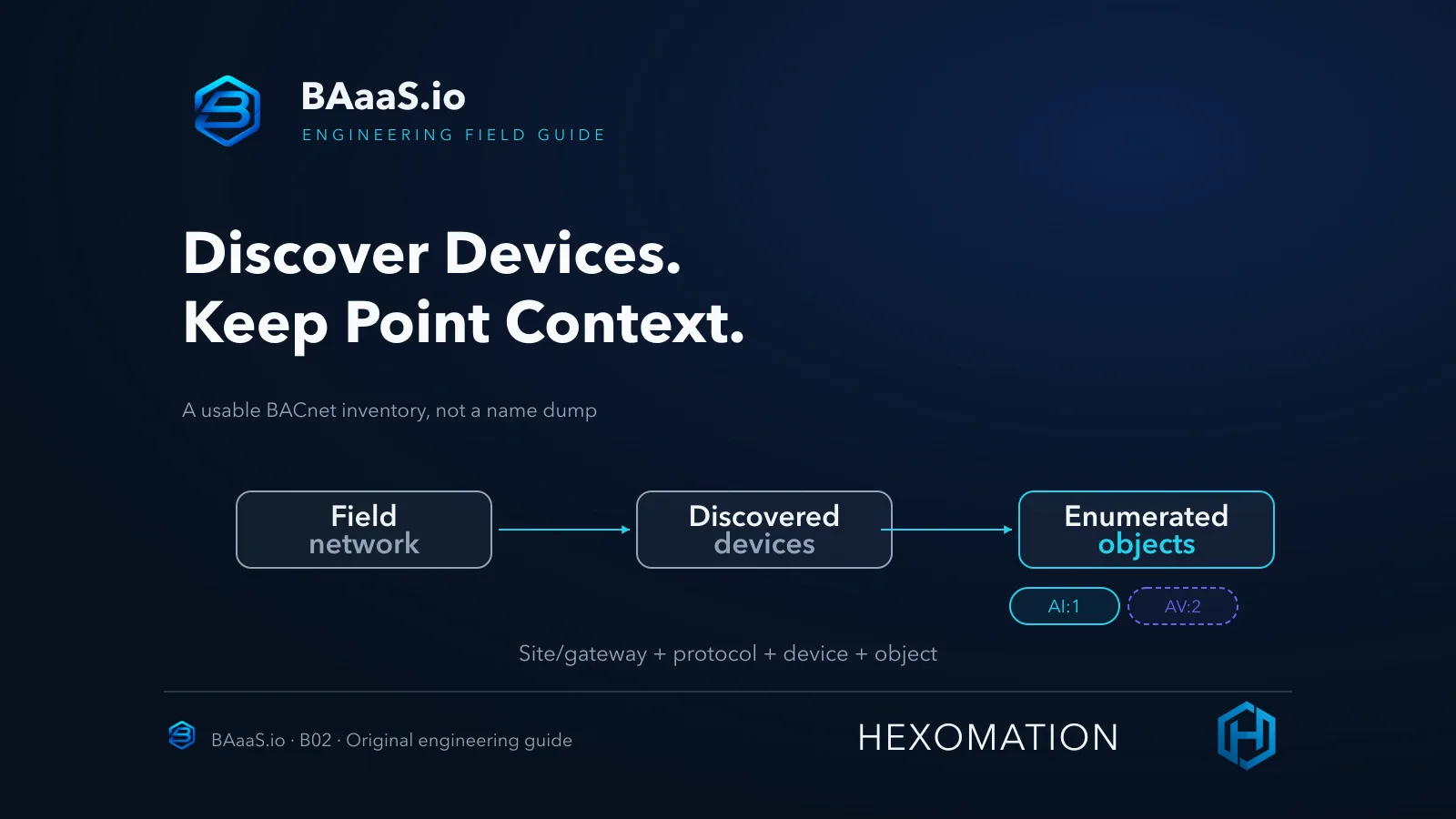
Discovery, register mapping and topic learning — the pieces covered by the earlier articles in this series — all end at the same doorway: points that could be monitored. This article is about what happens after you cross it, when collection actually starts.
A quick scope note on the word “monitoring” here: this piece covers getting values — the collection side — not what you do with them next. Alarms, trends and the operational layer on top of collected data each have their own upcoming pieces; the collection decision is upstream of all of them.
The four collection methods
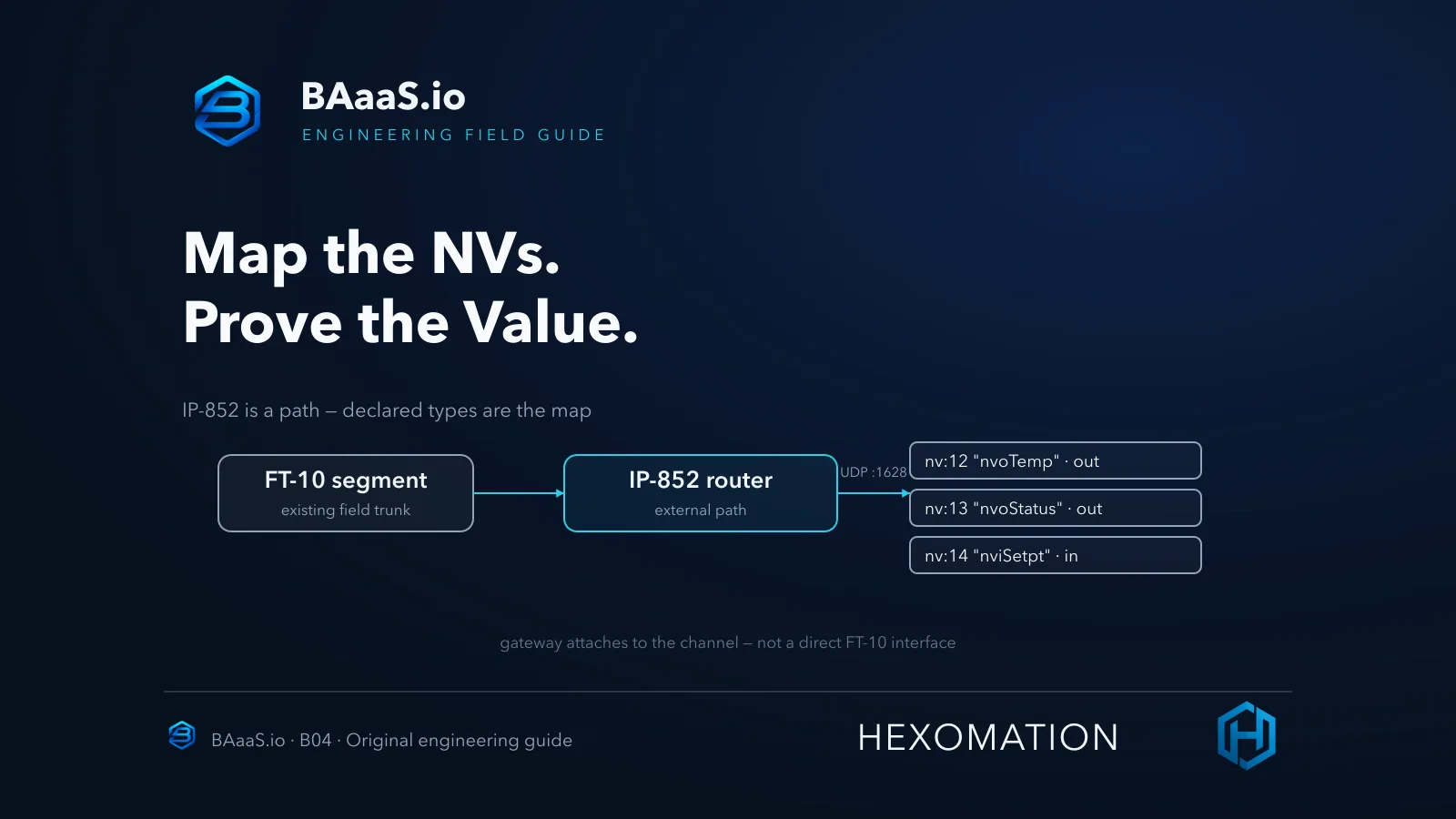
Each protocol brings its own mechanism, and they’re not interchangeable. BACnet supports COV — the device itself pushes change-of-value notifications — where the device supports it; otherwise polling. Modbus and LonWorks poll on the schedules you set — there is no standard Modbus or LonWorks COV on this path, so the interval is the lever you choose. MQTT subscribes — the broker delivers publishes as they arrive.
That table is the strategy in miniature — with an honesty caveat that matters: the interval is one influence on freshness, not a bound on it. Transport failures, queueing, source update rate, device-side caching and channel capacity all sit between your schedule and a fresh value; no collection mode promises a strict freshness bound. Design accordingly rather than assuming “monitoring” means the same thing everywhere.
It also explains why collection questions can’t be answered generically. “Is the point being monitored?” splits into three different questions depending on the row: is the COV subscription alive and renewing, is the poll actually running on schedule, or is the subscription receiving — three different facts with three different places to look.
COV is a subscription you must keep alive
When a BACnet device reports COV support, the platform chooses the COV path — an event-driven subscription the device maintains. The honest caveats: COV needs renewal, a failed initial subscription or exception falls back to polling as a one-time recovery, and none of that promises perpetual automatic fallback later. A quiet COV point is not automatically evidence of failure — nor evidence of health — until you check the renewal state and, where needed, an independent reading.
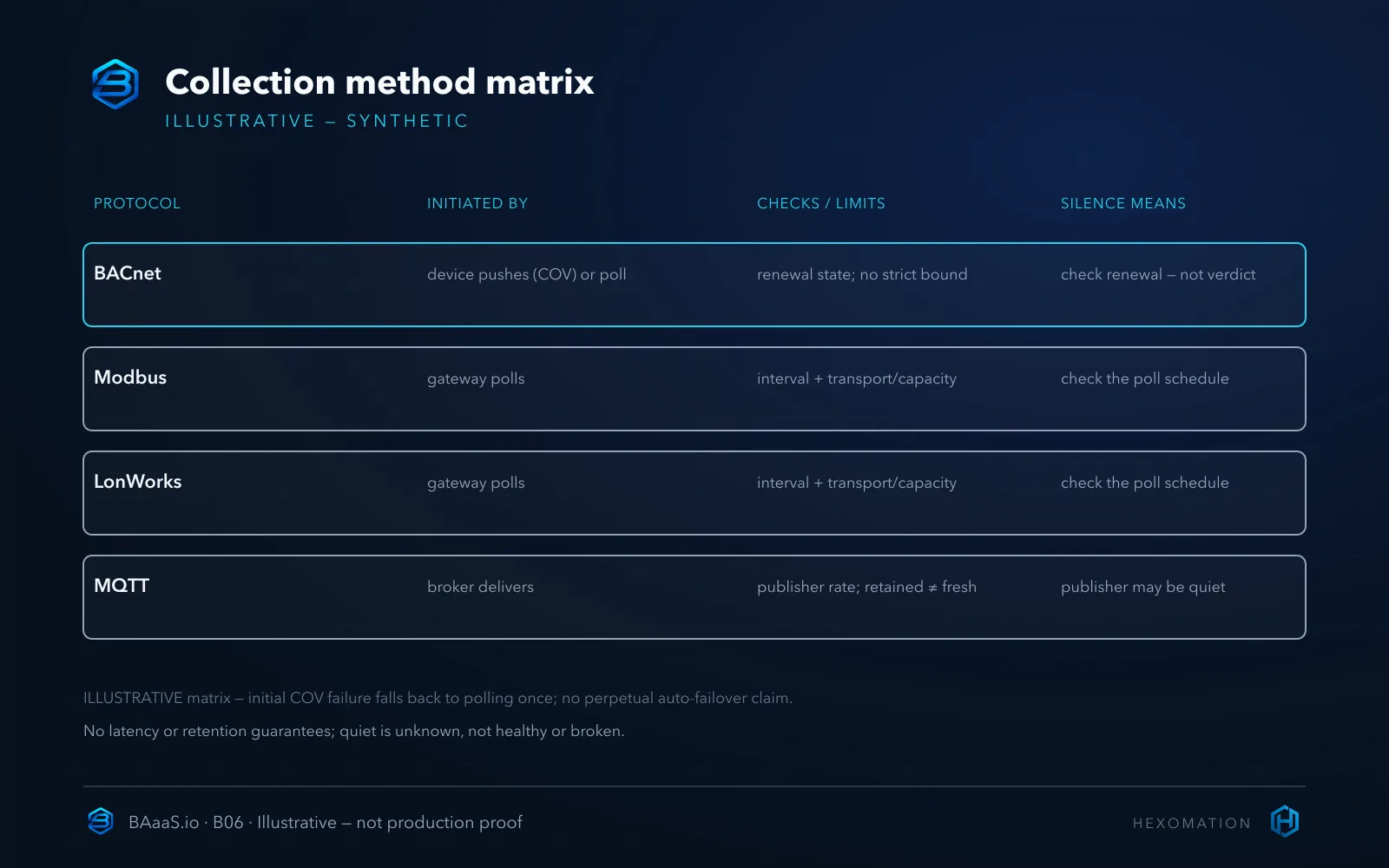
The practical rule: confirm the actual resulting collection mode rather than the one you expected. An enabled flag or a configured preference is the intention; the observed path — COV actively renewing, a poll actually running, a subscription actually receiving — is the fact.
The renewal lifecycle deserves its own check: a subscription that expired quietly shows a stale value alongside an “enabled” flag — a combination that looks healthy on the surface and isn’t. Where the point matters, a periodic renewal check — or an independent reading on a schedule — is the honest backstop.
Polling is the honest default
Where COV isn’t available — every Modbus register, every LonWorks NV, every BACnet point whose device doesn’t support subscriptions — polling carries the load, and the interval is a trade-off, not a default to copy. Faster intervals mean fresher data and more network work; slower intervals reduce load and accept more staleness. The right number comes from what the point is for and what the segment can bear — a shared MS/TP trunk does not get the same treatment as a lightly-loaded IP segment.
And there are no invented latency numbers to lean on: what you validate is the behavior on your network — that a poll actually runs at the cadence you set and the values move when the plant moves. Poll load is a design choice to prove against actual capacity, not a spec-sheet guarantee.
Start conservative and tighten where the point justifies it. An AHU supply-air temperature drifting over minutes doesn’t need the same cadence as a fault line, and over-polling a shared segment is how a monitoring rollout quietly degrades the very network it watches.
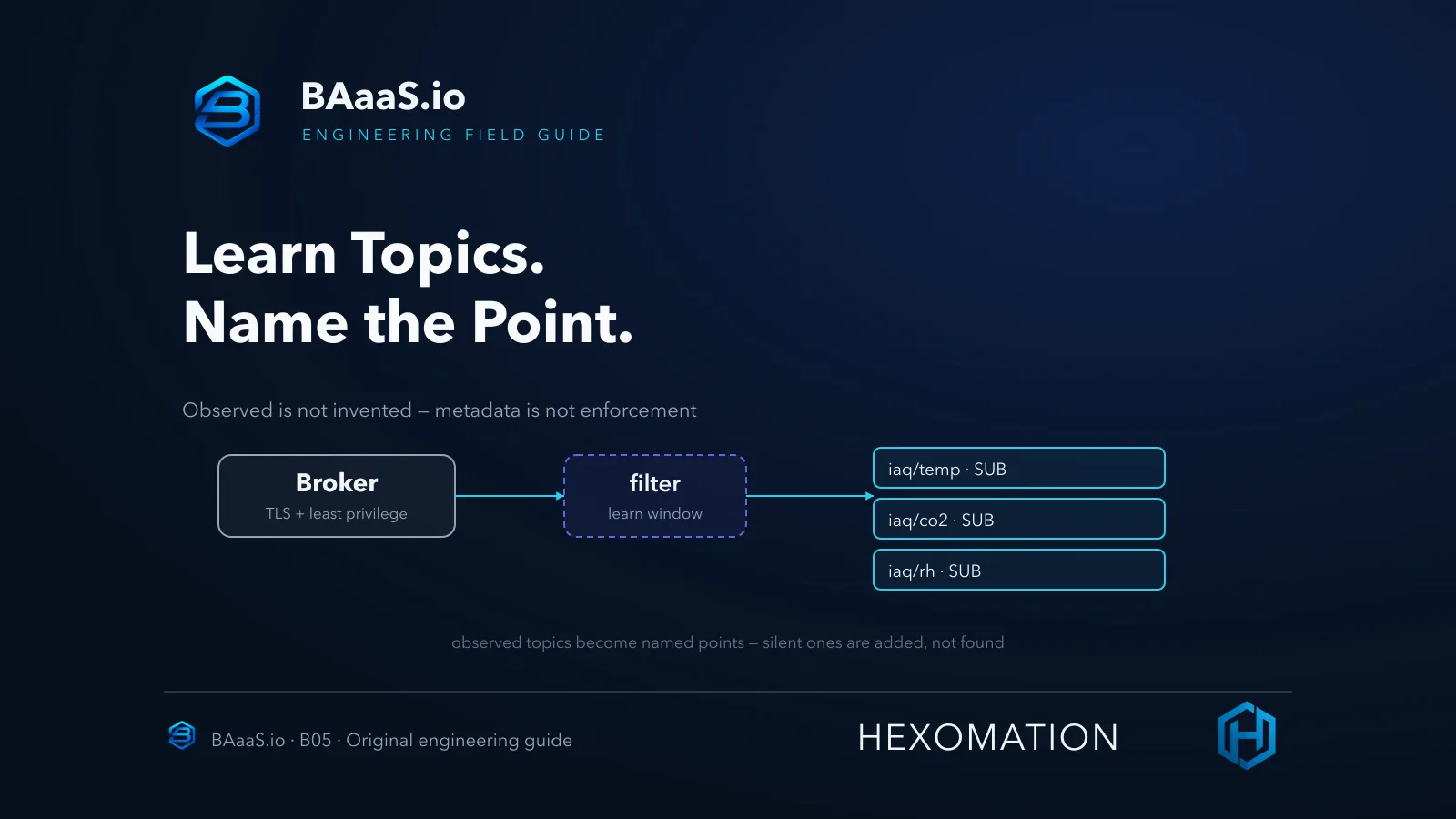
MQTT subscriptions inherit the publisher
An MQTT point’s freshness is whatever the publisher does — retained messages can deliver a healthy-looking last-known value for a source that stopped publishing an hour ago, and the subscription receiving a payload is not the source producing a new payload. Freshness on this path means watching what the publisher emits, not what the broker last stored.
The unifying principle across all four: a non-empty stored value or an “enabled” flag does not prove a fresh sample or a healthy collection path — it proves data arrived at some point. Freshness means comparing a measurement timestamp against receipt time where a source timestamp is provided — and where none exists, receipt alone cannot prove source freshness. Treat quiet points as unknown until checked, not as silently healthy.
This is also where retained MQTT data is easiest to misread: the broker’s retained message arrives promptly on subscribe and can look exactly like a fresh measurement — the value was delivered now, but produced whenever the publisher last spoke. Delivery recency and measurement recency are different clocks.
Identity first, freshness second
Every collection question dissolves if the point isn’t the point. Protocol-plus-device-plus-point is the minimum identity: a numeric device ID is per-protocol — BACnet device 5, Modbus slave 5 and MQTT device 5 are three different rows — and matching data to the wrong row produces a confident monitoring stream of the wrong plant.
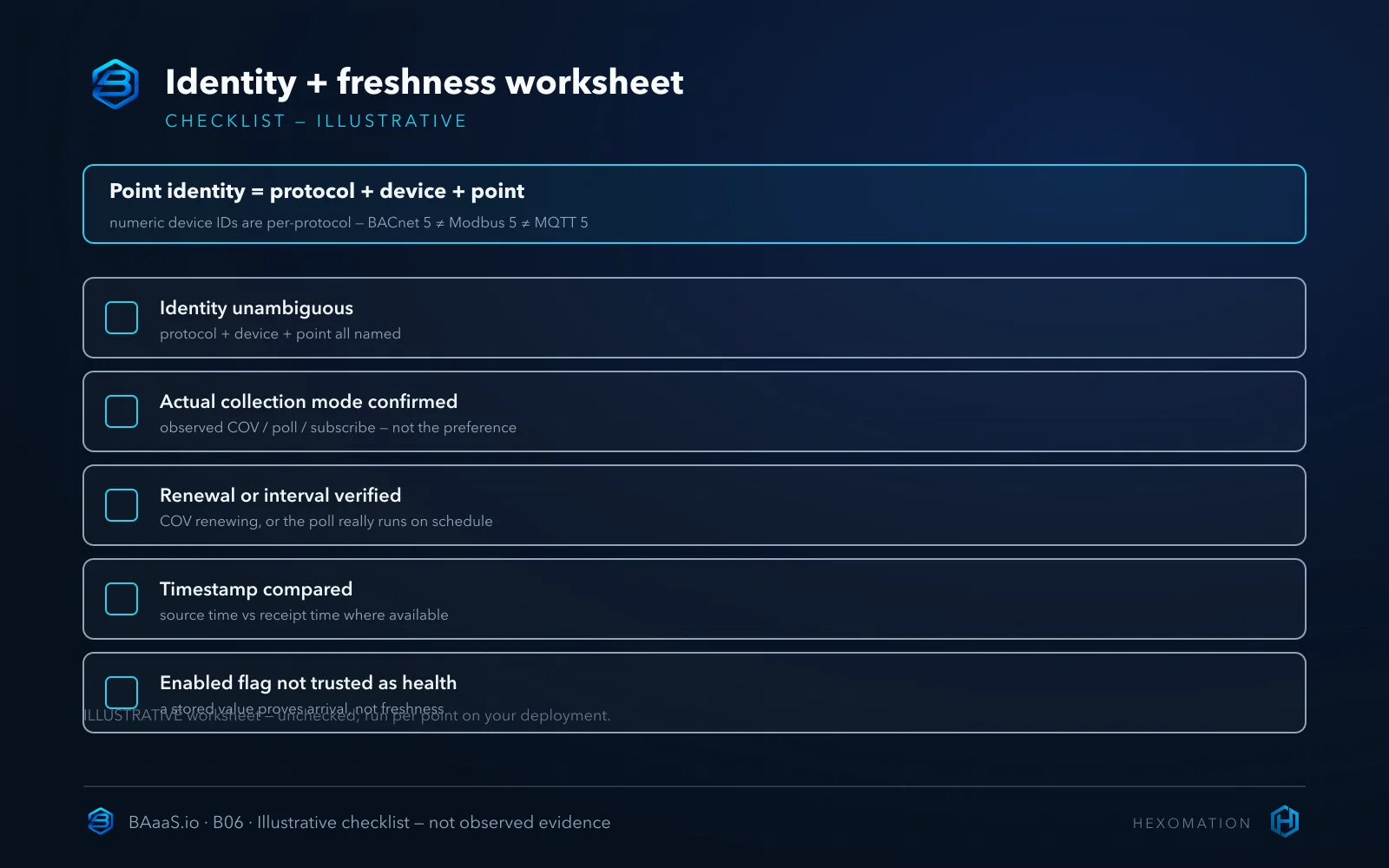
So the triage order on any suspect point: is the identity unambiguous (protocol, device, point)? What is the actual collection mode — COV, poll, subscribe? Is the renewal or interval verified? And where the source provides a timestamp, does it compare cleanly against receipt? An answer you can’t give from evidence is a point you don’t understand yet.
Keep that worksheet deliberately empty until it’s run: the four checks on it are questions for your deployment, not marks this article earned — the point of the figure is the shape of the audit, not the appearance of a passing one.
The fair alternative and the limits
Where the unified collection earns its place: one operational view across event and poll sources — an AHU sensor on COV, a Modbus meter on a 60-second poll, an MQTT temperature on subscription — all compared on the same dashboard rather than four viewer windows. Where protocol-specific tools still help is transport diagnostics: when a COV subscription won’t renew, the question lives on the BACnet side.
The stated limits hold: this article owns collection, not historical retention, fault-rule design or discovery procedures — and no promises that every update is instantaneous or that quiet means broken (or healthy). Collection is the input to operations, not the operation itself.
Judge the fit honestly, too: the unified view pays off when you need to compare across protocols in one place; when the question is a single-protocol transport problem, the protocol’s own diagnostic tooling often answers faster.
Choose the method per point
The sequence that holds up: identify protocol-plus-device-plus-point, confirm the actual collection mode each point lands on, validate poll intervals against real capacity, treat subscription and COV freshness against source timestamps where provided — and only then judge the data. Inventory tells you what exists; collection tells you what’s live.
Done right, the payoff is a monitoring estate you can explain: for every point, you can say which mechanism carries it, how fresh it can honestly be, and what silence would mean — rather than a dashboard that reports something on every row.
To design a monitored-point pilot, review the capability overview at BAaaS.io/features, and see the inventory walkthrough for the discovery half of this discipline.