
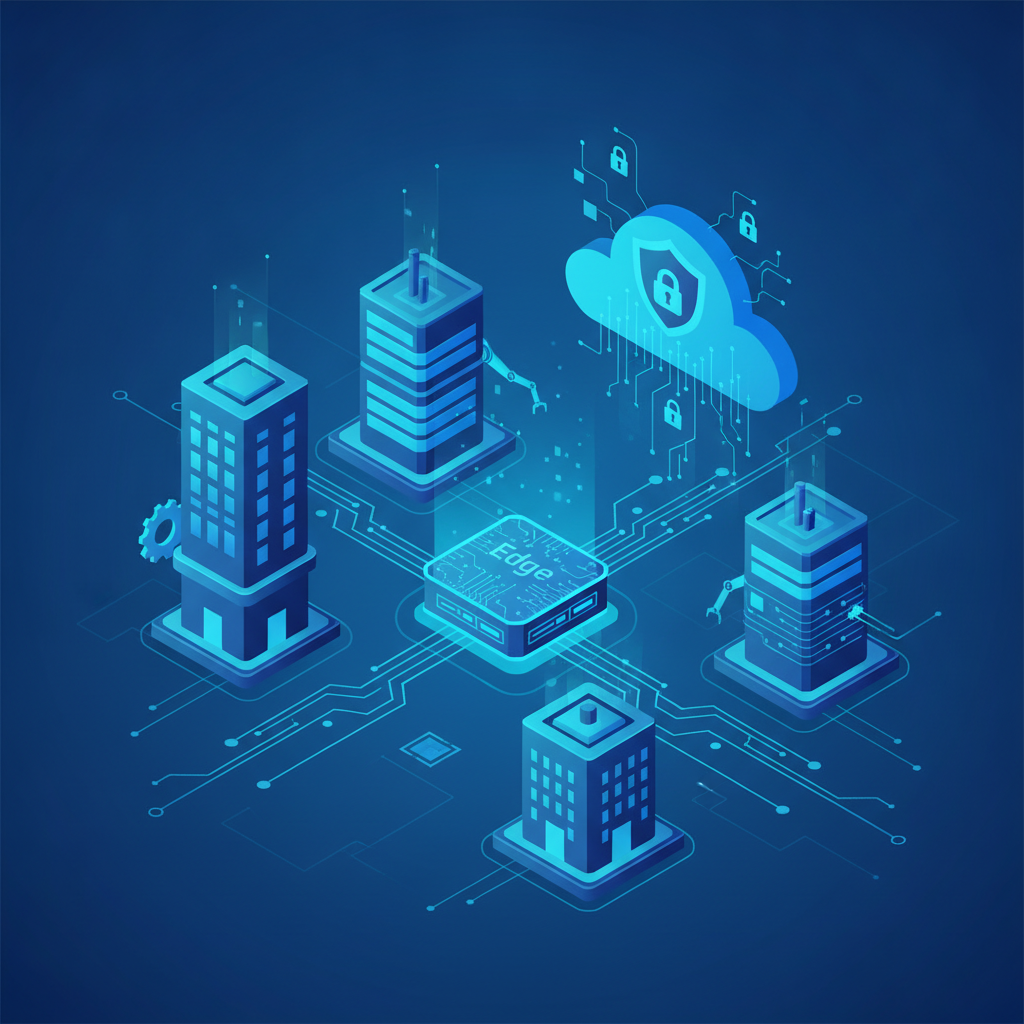
In modern industrial and commercial environments, deploying a purely cloud-based architecture is a recipe for operational vulnerability. While the cloud offers limitless analytics and storage, it struggles with the rigid demands of latency, network reliability, and localized safety protocols. This is where hybrid Industrial IoT (IIoT) architectures bridge the gap, deploying edge software directly on-site to act as the crucial middleman between field devices and enterprise systems.
In this context, industrial edge software refers to applications running on local gateways, industrial PCs, or localized servers. It operates next to your PLCs and safety layers, continuously collecting data over diverse industrial protocols. By handling protocol translation, data filtering, and supervisory alarms locally, edge computing ensures that critical infrastructure—from manufacturing lines to modern smart buildings—remains responsive even when the cloud uplink fails.
Bridging the Gap: Why Cloud-Only Fails in Automation
Many industrial sites and commercial properties simply cannot run critical operations from a remote data center. As highlighted by NIST SP 800-82 guidelines for operational technology (OT) security, cloud services introduce availability challenges due to connection drops and system latency. When a wide-area network (WAN) goes down, local processes must continue to operate safely and predictably.
According to the ISA-95 standard, real-time responses at the control level occur in sub-seconds. Supervisory rules and alarms on an edge node operate on a seconds-based timescale, making them perfectly suited for local execution. Running these supervisory layers on-site guarantees that equipment alerts and building automation logic do not have to wait for a round-trip routing to a remote server.
This localized tier does not replace programmable logic controllers (PLCs) or safety instrumented systems. Instead, it provides a highly resilient data and supervisory layer that guarantees localized operational continuity while intelligently feeding the broader enterprise cloud.
Protocol Translation and ICS Security at the Edge
Industrial environments are notoriously fragmented, relying on a patchwork of protocols tailored to specific jobs. A robust edge node must fluently translate legacy and modern standards, seamlessly converting Modbus, BACnet, and OPC UA into modern messaging transports like MQTT. MQTT 5.0, for instance, allows edge gateways to publish lightweight, payload-agnostic telemetry to enterprise systems efficiently.
However, this connectivity introduces severe ICS security risks if improperly managed. Industry standards strongly advise restricting industrial control protocols to isolated OT network segments. The exchange between operational technology and IT systems should be strictly brokered through a localized DMZ using secure protocols like MQTT over TLS or OPC UA over TLS.
Edge software acts as a critical security boundary. Gateways enforce outbound-only communication, preventing unauthorized inbound access from the public internet. Dividing systems into secure zones and conduits limits the blast radius of a potential cyber-attack, protecting vulnerable legacy devices from machine-in-the-middle exploits.
Data Resilience: Navigating Network Outages
When the network connection drops, an edge gateway must rely on its store-and-forward capabilities to preserve critical telemetry. The survival of an offline site depends entirely on its configured buffer limits, which are bound by time-to-live (TTL) settings and available physical disk space. If a facility loses connectivity for 24 hours, the edge node must safely queue that data.
Architects must make calculated decisions on how to handle buffer overflows. Should the system drop the oldest data, reject the newest readings, or push back on the data source? In protocols like MQTT, Quality of Service (QoS) levels dictate delivery guarantees. A QoS 1 setting assures that messages arrive once connectivity is restored, though duplicates may occur.
Before deploying any hybrid IIoT architecture, teams must define their offline survival requirements. Understanding peak data rates, buffer sizing, and the handling of back-filled timestamp data is non-negotiable for preserving accurate historical records in plant historians or cloud databases.
Next-Generation Building Automation with BAaaS.io
Applying these robust IIoT principles to commercial real estate transforms traditional properties into highly optimized smart buildings. However, managing the complex convergence of HVAC, security, lighting, and ICS security requires a specialized, managed ecosystem. This is where BAaaS.io (Building Automation as a Service) provides a definitive architectural advantage.
By leveraging a centralized, hybrid approach, BAaaS.io delivers real-time telemetry across an entire property. Its unified network monitors temperature, occupancy, and lighting levels, creating an integrated building information sphere. This enables automated environmental adjustments that directly improve tenant comfort and optimize energy efficiency, drastically reducing the building’s carbon footprint.
Furthermore, BAaaS.io translates localized edge data into actionable operations and maintenance insights. Real-time equipment monitoring detects anomalies early, allowing facility teams to shift from reactive repairs to proactive maintenance. With built-in authentication and robust access controls, the platform ensures that both building automation data and physical infrastructure remain completely secure.
Conclusion
The push for data-driven operations does not eliminate the need for localized control and security. Hybrid IIoT deployments successfully balance the limitless processing power of the cloud with the strict reliability, latency, and ICS security requirements of the physical edge. Whether orchestrating a manufacturing plant or implementing advanced building automation, edge software remains the undisputed backbone of resilient infrastructure.
By effectively managing protocol translation, securing network boundaries, and handling localized outages, edge gateways ensure operational continuity. As facilities increasingly rely on interconnected systems, embracing robust edge-to-cloud architectures is no longer just a technical best practice—it is a fundamental business necessity.